
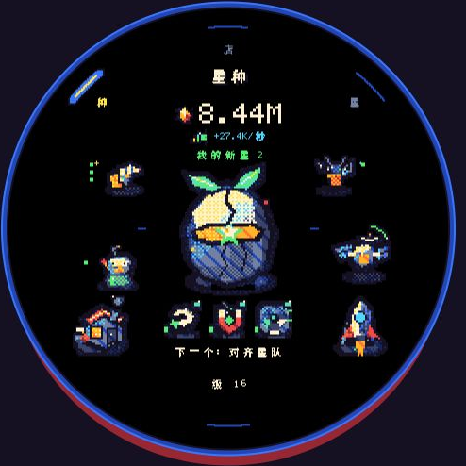
INTERNAL ID / core
SEED
- PLAYER QUESTION
- How do I earn more Sparks?
- PRIMARY ACTION
- Tap and three-stage hold
- SECONDARY ENTRY
- Tap-power upgrade
One-sentence pitch: run a pocket workshop that repeatedly launches new stars, using taps, holds, rotation and tilt inside a 1.75-inch, 466×466 round touch display.
POCKET STAR WORKSHOP borrows the progression rhythm of incremental games without copying the familiar “large center object plus surrounding panels” layout. A round display has no stable corners, little room for lists, and a finger can cover a large part of the scene. Circular geometry, single-pointer transactions and short-lived information density are therefore foundational constraints rather than a final visual skin.
SEED asks how to earn more Sparks; SHOP asks who produces them and how they cooperate; STAR asks when to begin the next star.
The center creates, the inner ring coordinates, the edge navigates, and tilt supplies physical response.
Numbers, maker placement, tool states, TEAM links and archived stars all express progression.
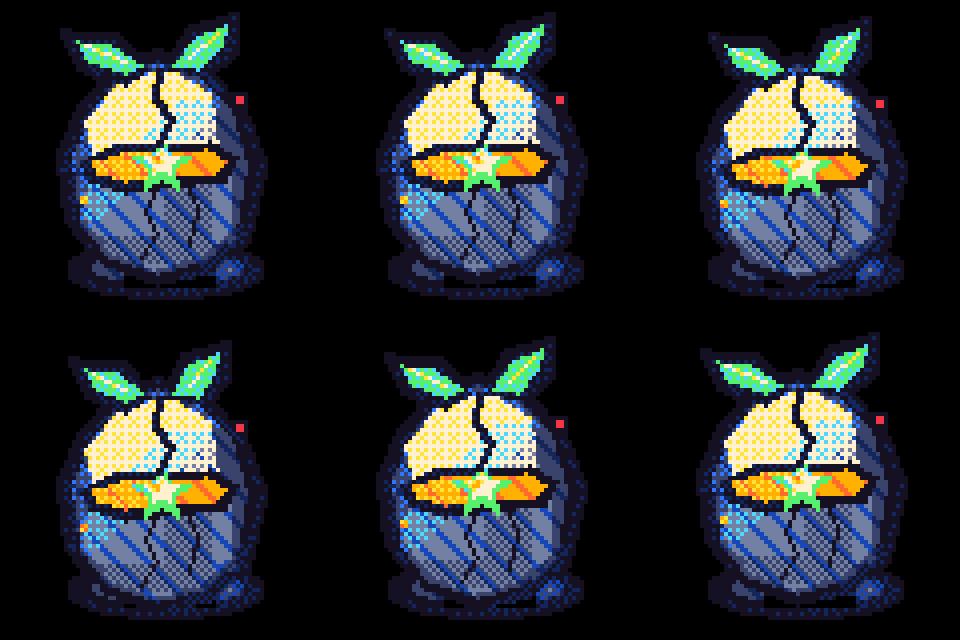 ACTIVE STEPTap the Seed
The implementation is not one giant UI controller. The web prototype separates a pure GameEngine, economic formulas, circular geometry, Canvas rendering, particles/frame sequences and save storage. The ESP32 version preserves those boundaries while replacing their implementations with C++, RGB565, RTC and NVS.
INTERNAL ID / core
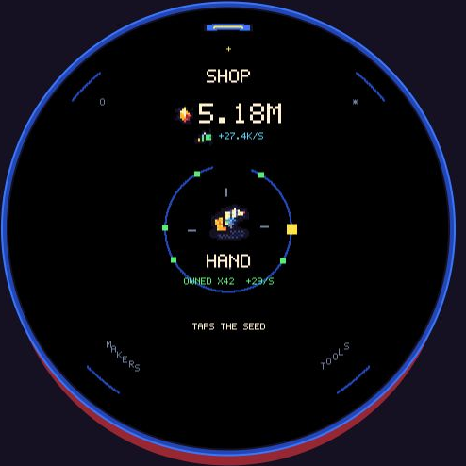
INTERNAL ID / grow
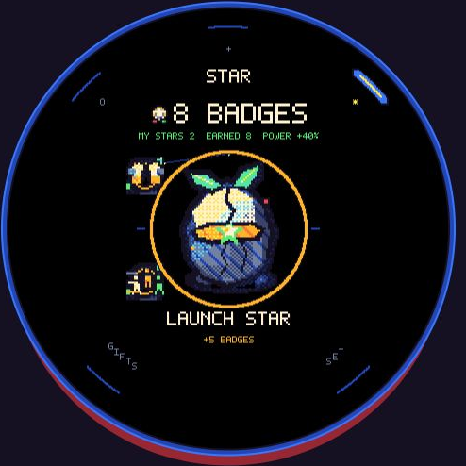
INTERNAL ID / loop
CONSOLE-RGB16: black, saturated red/yellow/blue, cyan information layers and continuous dark outlines.The same SEED composition upgraded to 16 colors, continuous dark outlines and a complete CJK pixel layer.
View commit 8c4b0d2